
OZworld and CHICO CARLITO Win ¥50 Million at BATTLE SUMMIT III
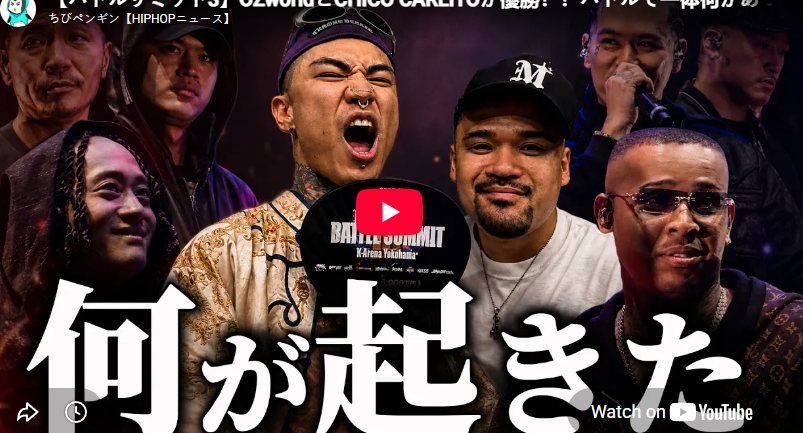
OZworld and CHICO CARLITO have been crowned the winners of BATTLE SUMMIT III, taking home the tournament’s ¥50 million prize after defeating Zeebra and T-Pablow in the final.
The major Japanese hip-hop battle event took place on August 11 at K-Arena Yokohama, bringing together some of the country’s most recognizable rappers for a high-profile team competition.
The victory gives OZworld and CHICO CARLITO another major achievement while adding a new chapter to the history of one of Japan’s biggest rap battle events.
OZworld and CHICO CARLITO Take the Championship
The final matchup brought together two teams representing different generations and styles of Japanese hip-hop.
OZworld and CHICO CARLITO faced veteran Japanese hip-hop figure Zeebra alongside T-Pablow, one of the artists who emerged from Japan’s battle-rap and street-rap culture.
After the final battle, OZworld and CHICO CARLITO were declared the winners.
The championship came with a ¥50 million prize, making the event one of the most significant competitive opportunities currently available to Japanese rappers.
For the winning duo, the result represents both a financial reward and a major competitive achievement.
BATTLE SUMMIT Brings Japan’s Rap Community Together
BATTLE SUMMIT has become an important event within Japanese hip-hop because it brings together artists from different generations and parts of the country’s rap culture.
Unlike a conventional concert or festival, the focus is competition.
Rappers are required to perform under pressure while responding to opponents and adapting to the atmosphere of the battle.
That format gives the event a different energy from a traditional live show.
It also allows audiences to see established artists in a competitive environment rather than simply watching them perform their most familiar songs.
A Major Matchup of Generations
The final between OZworld and CHICO CARLITO against Zeebra and T-Pablow also created an interesting generational contrast.
Zeebra is one of the foundational figures in Japanese hip-hop and has played a major role in the development of rap culture in Japan.
T-Pablow, meanwhile, became one of the most recognizable younger figures through his involvement with the Japanese hip-hop collective BAD HOP.
On the opposing side, OZworld and CHICO CARLITO represent another generation of Japanese rappers who have developed their own identities while contributing to the continued evolution of the country’s rap scene.
Putting these artists together in a competitive format gave the final additional significance.
The Road to the Final
The tournament featured multiple high-profile matchups before reaching the championship battle.
Among the notable contests was CHEHON and Red Eye against Eric.B.Jr and Watson.
The matchup brought together artists with different backgrounds and styles, demonstrating the range of talent involved in the competition.
These battles are part of what makes BATTLE SUMMIT different from a conventional festival.
The audience is not simply waiting for a headline performance.
Every matchup can change the direction of the tournament, creating a competitive atmosphere throughout the event.
K-Arena Yokohama Hosts the Competition
The event took place at K-Arena Yokohama, one of Japan’s major entertainment venues.
Holding a major hip-hop battle at an arena of this scale reflects how far Japanese rap culture has developed.
Battle rap was historically associated with smaller venues and underground communities.
Today, major competitions can attract audiences large enough to fill some of Japan’s biggest entertainment spaces.
BATTLE SUMMIT III demonstrates that competitive hip-hop has become an important part of the country’s mainstream rap ecosystem.
Why the ¥50 Million Prize Matters
The ¥50 million prize is another indication of the scale of the event.
Hip-hop battles have traditionally been driven primarily by reputation, recognition and competition.
A prize of this size introduces another dimension.
For participating artists, winning can provide both financial benefits and increased visibility.
It also demonstrates the commercial potential surrounding Japanese hip-hop.
The genre has grown considerably in recent years, with artists selling out larger venues, appearing at major festivals and attracting international audiences.
BATTLE SUMMIT’s prize pool reflects that expanding market.
OZworld Continues His Rise
The victory adds another important achievement to OZworld’s career.
Known for his distinctive artistic identity and unconventional approach to hip-hop, OZworld has established himself as one of the recognizable artists within Japan’s contemporary rap scene.
His success has not been limited to traditional battle culture.
He has developed a broader musical identity through recorded music, collaborations and live performances.
Winning BATTLE SUMMIT III adds a competitive achievement to that career.
CHICO CARLITO Adds Another Major Achievement
For CHICO CARLITO, the victory is equally significant.
The Okinawa-born rapper has been an important figure within Japan’s rap scene for years and has built a reputation through both recorded music and competitive rap.
His partnership with OZworld proved successful under the BATTLE SUMMIT format.
The victory also highlights the continuing importance of artists from outside Tokyo.
Japanese hip-hop has developed strong regional scenes, and artists from Okinawa and other parts of the country have increasingly become important voices within the national culture.
Japanese Battle Rap Continues Evolving
The success of BATTLE SUMMIT III reflects the continued popularity of competitive rap in Japan.
Battle culture has been part of Japanese hip-hop for decades, but modern events have helped bring it to much larger audiences.
Online platforms have also changed the way battles are consumed.
Performances can reach viewers far beyond the venue, allowing memorable moments to circulate across social media and video platforms.
That exposure can help turn individual battle performances into major talking points within Japanese hip-hop.
More Than Just a Competition
BATTLE SUMMIT III also demonstrates how different parts of Japanese hip-hop can coexist.
Veteran artists, established rappers, younger performers and battle specialists can all share the same platform.
That mixture creates opportunities for cross-generational encounters that might not happen during a conventional concert.
The final matchup between OZworld, CHICO CARLITO, Zeebra and T-Pablow was a clear example.
Four artists with different experiences and perspectives came together under one competitive format.
What the Victory Means for Japanese Hip-Hop
The event’s conclusion adds another major moment to what has already been a busy year for Japanese hip-hop.
The country’s biggest rappers continue expanding into international markets, while domestic festivals and battle events attract increasingly large audiences.
BATTLE SUMMIT III sits at the intersection of those developments.
It preserves the competitive tradition of hip-hop while presenting it on a large commercial stage.
That balance between underground culture and mainstream visibility has become one of the defining characteristics of modern Japanese rap.
OZworld and CHICO CARLITO Leave as Champions
After a night of high-profile matchups at K-Arena Yokohama, OZworld and CHICO CARLITO emerged as the champions of BATTLE SUMMIT III.
Their victory over Zeebra and T-Pablow in the final secured the ¥50 million prize and gave both artists another major milestone in their careers.
The tournament also reinforced the continuing importance of battle culture within Japanese hip-hop.
As the scene continues growing, events such as BATTLE SUMMIT provide a platform where established legends and newer stars can compete on the same stage.
For OZworld and CHICO CARLITO, however, the result is simple: they entered BATTLE SUMMIT III as competitors and left K-Arena Yokohama as champions.